
Multi-region EKS for a global HR platform
The problem
An AI-native HR operating system was growing its customer base across continents. A single-region AWS setup had worked during the early phase, but it could not hold. HR data is sensitive - customers in Europe, Asia, and North America had legitimate expectations that their employee data would stay in their region, and latency to a distant cluster was already becoming a friction point in sales conversations.
Beyond data residency and latency, there was an operational consistency problem. Without a deliberate multi-region design, each regional deployment becomes a one-off: different configs, different runbooks, different failure modes. The platform sat on a trusted enterprise SaaS foundation - it had to be operated with the same rigour in every region, not improvised.
What we built
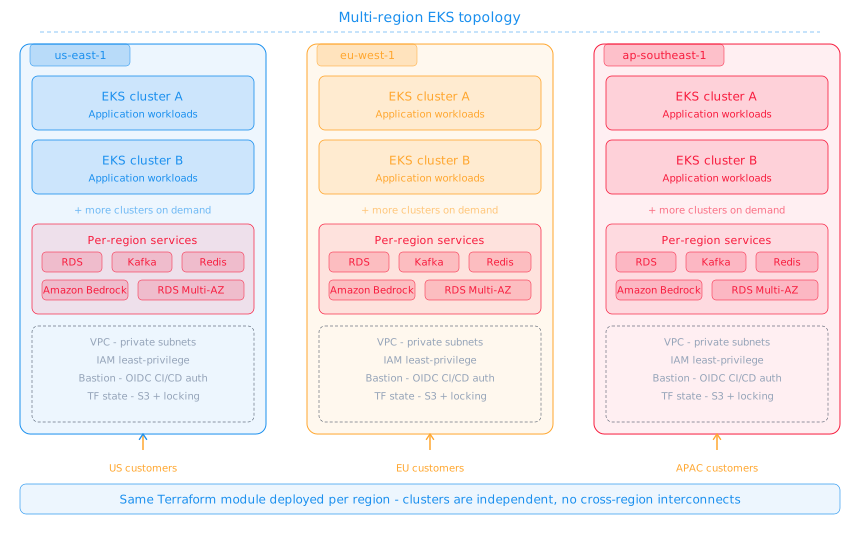
The solution is a repeating regional unit - the same cluster topology, the same service stack, the same Terraform module - deployed into each AWS region where customers need to be. Adding a new region is not a project; it is applying the same pattern to a new target.
Multi-region EKS topology. Each region runs one or more Amazon EKS clusters. Each cluster lives in its own dedicated VPC with non-overlapping CIDR ranges, sized so all VPCs remain VPN-routable if the company needs centralised access in future. Clusters are independent - a failure in one region does not cascade.
Per-region service stack. Every region runs the same set of services:
- Amazon RDS (PostgreSQL) - managed relational database, Multi-AZ for availability. HR data stays in region.
- Apache Kafka - in-cluster event backbone for async workflows and HR process orchestration.
- Redis - in-cluster caching layer for session data and frequently accessed HR records.
- Amazon Bedrock - AI capability layer powering the AI-native features of the HR product, accessed per-region.
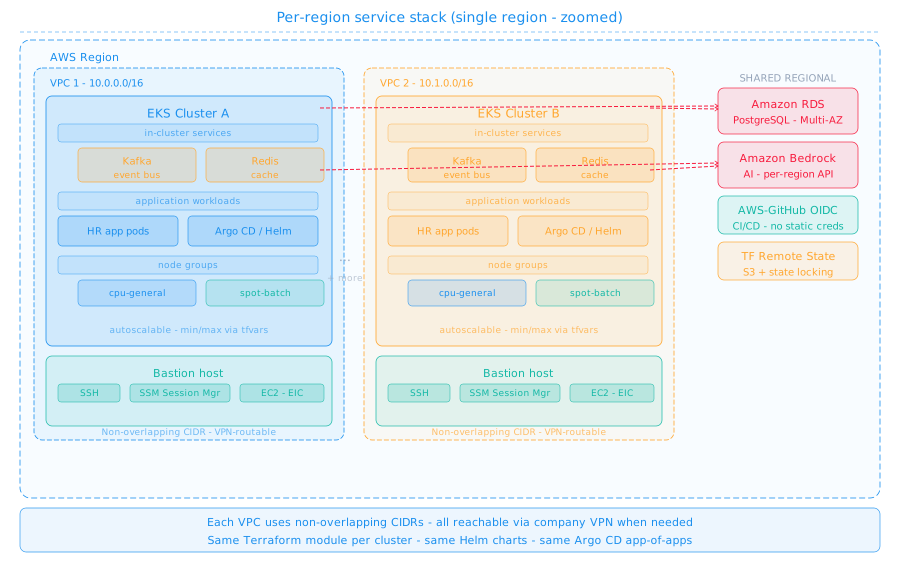
Networking and access. Each VPC has its own bastion host for operator access, supporting SSH, SSM Session Manager, and EC2 Instance Connect. AWS-GitHub OIDC handles CI/CD pipeline authentication - no long-lived credentials in GitHub secrets. Terraform remote state is stored in S3 per region with state locking.
Consistent deployment model. The entire regional stack is a Terraform module, parameterised by region and cluster size. Deploying to a new region is terraform apply with a new tfvars file. The same Helm charts deploy the application layer to every cluster via Argo CD with app-of-apps, so rollouts are consistent and auditable across regions.
Key outcomes
- Region-local by default. Every customer's workloads and data run in the nearest AWS region. Data residency requirements are met at the topology level, not patched in after the fact.
- Each cluster in its own VPC. Non-overlapping CIDRs across all VPCs keep routing clean and the fleet VPN-ready for centralised access when needed.
- Consistent everywhere. The same Terraform module, Helm charts, and Argo CD app-of-apps deploy to every region. A new region is a config change, not a build.
- Independent by design. Clusters are not interconnected. A regional failure stays regional - no blast radius across the fleet.
- Secure access without static credentials. Every VPC bastion supports SSH, SSM Session Manager, and EC2 Instance Connect. AWS-GitHub OIDC handles CI/CD with no long-lived secrets.
- AI capabilities where needed. Amazon Bedrock integrates per-region, keeping AI feature calls close to the data they operate on.